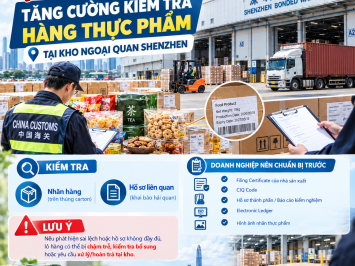


Food additives are an indispensable group of products in the food processing and F&B manufacturing industry. However, because these products have a direct impact on human health, the import procedures for food additives are subject to strict management and inspection by the Ministry of Health and Vietnamese Customs.
If your business is preparing to import these products, it is essential to understand the relevant regulations and procedures below to ensure smooth customs clearance and avoid unexpected storage and demurrage costs.
1. Import Requirements for Food Additives
Before importing, businesses must determine whether the food additive is permitted for use in Vietnam.
-
Food additives must be included in the List of Food Additives Permitted for Use in Vietnam issued by the Ministry of Health under Circular No. 24/2019/TT-BYT and its amendments and supplements.
-
If the food additive is not included in the permitted list, the importer must obtain approval from the Ministry of Health before importing.
2. HS Code and Import Tax Determination
Food additives are diverse in terms of composition and characteristics. Therefore, their HS codes may fall under different chapters, commonly Chapters 21, 29, 33, 35, 38, etc.
Correct HS code classification is extremely important because it determines the applicable import duty, VAT, and import management requirements.
-
Import duty: Depends on the specific HS code. Businesses should request a valid Certificate of Origin (C/O) from their supplier, such as Form E, D, VJ, AK, etc., to take advantage of preferential special import duty rates, which may be reduced to 0% depending on the applicable tariff schedule.
-
Value Added Tax (VAT): Generally 8% or 10%, depending on the specific product and applicable regulations.
3. Import Procedure
The import procedure for food additives generally follows Decree No. 15/2018/ND-CP and involves several important steps.
Step 1: Product Self-Declaration – Required Before Importing
-
Import product samples for testing at laboratories recognized or designated by the competent authorities.
-
Based on the satisfactory test results, the business prepares and submits the Product Self-Declaration to the competent food safety authority in the locality.
-
Important: Food additive mixtures with new functions or products not included in the permitted list may be subject to Product Declaration Registration, which is a more complex procedure and generally takes more time.
Step 2: State Food Safety Inspection
When the goods arrive at the port, the importer must register for state food safety inspection with an authorized inspection organization, such as public health institutes or QUATEST organizations, depending on the applicable regulations and product category.
The customs clearance process may require satisfactory food safety inspection results before the shipment can be released.
Step 3: Customs Declaration and Clearance
The importer submits the electronic customs declaration and provides the required supporting documents. For yellow or red-channel declarations, additional documentary or physical inspection may be required.
Once all customs and specialized inspection requirements have been fulfilled, Customs will proceed with clearance of the shipment.
4. Import Customs Documentation
Businesses should prepare the following documents:
| Document | Purpose & Details |
|---|---|
| Customs Declaration | Electronic customs declaration submitted through the customs system. |
| Commercial Invoice | Commercial invoice for the shipment. |
| Packing List | Detailed packing information. |
| Bill of Lading (B/L) | Ocean bill of lading or air waybill, depending on the mode of transport. |
| Product Self-Declaration | Product self-declaration dossier submitted in accordance with applicable regulations. |
| Food Safety Inspection Documents | Satisfactory inspection result required for import clearance, where applicable. |
| Certificate of Origin (C/O) | Certificate of origin, if available, to claim preferential tariff treatment. |
| Other Documents (if applicable) | Certificate of Analysis (COA), original product labels, technical specifications, and other relevant documents. |
🤝 SONGWIN – FAST & COST-EFFECTIVE CUSTOMS CLEARANCE SOLUTIONS
The procedures for product declaration and food safety inspection require a high level of accuracy. Even a small error in the documentation can delay the shipment at the port, resulting in significant storage and demurrage costs and potentially disrupting your production schedule.
Songwin's comprehensive import-export logistics services help minimize these risks:
-
HS Code & Product Declaration Consulting: We assist with checking the applicable product list, regulatory requirements, laboratory testing, and product self-declaration procedures from A to Z.
-
Complete Documentation & Customs Clearance: Support for food safety inspection registration, customs declaration, and customs clearance.
-
Cost Optimization: Transparent quotations and support in maximizing tariff benefits through applicable C/O schemes, helping minimize unexpected costs.
-
Door-to-Door Delivery: Combined with our domestic trucking network, we safely transport your goods directly to your warehouse.
Don't let complicated import procedures disrupt your supply of raw materials.
Contact Songwin today for professional advice and the most efficient import and logistics solution for your business!
SONGWIN INTERNATIONAL LOGISTICS VIETNAM
📍 Address: 344 Nguyen Trong Tuyen, Tan Son Hoa Ward, Ho Chi Minh City, Vietnam
☎ Hotline: 083.681.3969 – 0373.262.105
📧 Email: Sales2@songwinlog.com
🌐 Website: www.songwinlog.net
![[Detailed Guide] Procedure for Obtaining a Certificate of Eligibility for Conditional Chemical Trading](https://songwinlog.net/thumbs/355x266x1/upload/news/bai-dang-instagram-thong-bao-lich-nghi-tet-2026-cao-cap-toi-gian-do-vang-1-3608.png)