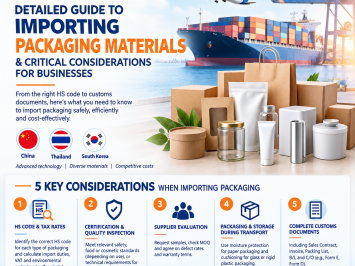


The demand for single-use food utensils, including plastic and paper containers, cups, bowls, trays, knives, spoons, forks, and straws, continues to grow in the Vietnamese market. However, because these products come into direct contact with food, they are subject to strict quality and safety regulations.
To help businesses understand the applicable legal requirements and optimize customs clearance time, Songwin Logistics has compiled a detailed guide to the import procedures and key considerations below.
1. Legal Framework for Importing Food-Contact Utensils
Imported disposable food containers and utensils are generally not prohibited from entering Vietnam. However, they must comply with applicable legal regulations, including:
-
Decree No. 15/2018/ND-CP: Provides detailed regulations implementing certain provisions of the Law on Food Safety. Food containers, packaging, and utensils that come into direct contact with food may be subject to product self-declaration and imported food safety inspection, depending on the product category and applicable regulations.
-
Decree No. 43/2017/ND-CP and Decree No. 111/2021/ND-CP: Regulate the labeling of goods.
-
Circular No. 38/2015/TT-BTC, as amended and supplemented by Circular No. 39/2018/TT-BTC: Regulates customs procedures, customs supervision, and inspection.
2. HS Codes and Import Duties
Correct HS code classification helps businesses determine applicable import duties and value-added tax (VAT). The following are common reference codes for disposable food utensils:
A. Plastic Utensils
-
HS Code 3924.10.00: Tableware and kitchenware made of plastics, such as disposable plastic bowls, plates, spoons, forks, and cups.
-
HS Codes 3923.10 / 3923.90: Certain plastic boxes, containers, and trays used for packaging or transporting goods, subject to the product's specific characteristics and intended use.
-
MFN import duty: Approximately 10%–22%, depending on the specific HS code.
-
VAT: Generally 8%–10%, depending on the applicable tax policy and product classification.
B. Paper and Paperboard Utensils
-
HS Codes 4823.69.00 / 4823.61.00: Certain trays, plates, bowls, and cups made of paper or paperboard.
-
HS Codes 4819.10 / 4819.20: Corrugated or non-corrugated paper and paperboard cartons and folding boxes, depending on their construction and characteristics.
-
MFN import duty: Approximately 15%–20%, depending on the specific HS code.
-
VAT: Generally 8%–10%, depending on the applicable tax policy and product classification.
Recommendation: Businesses should request a valid Certificate of Origin (C/O) from their overseas suppliers, such as Form E for eligible goods originating in China, Form D for eligible ASEAN-origin goods, or Form VK for eligible goods originating in South Korea. Preferential tariff rates may reduce import duties to 0%–5%, depending on the applicable Free Trade Agreement (FTA), rules of origin, and product-specific tariff schedule.
3. Import Procedures for Single-Use Food Utensils
Step 1: Complete Product Self-Declaration, Where Required
Before importing or placing the product on the Vietnamese market, businesses should determine whether product self-declaration is required under the applicable food safety regulations.
Where applicable, the importer should arrange for product samples to be tested by a qualified testing laboratory to assess relevant safety criteria, including the migration of potentially harmful substances.
The self-declaration dossier generally includes:
-
Product self-declaration form, using Form No. 01 under Decree No. 15/2018/ND-CP.
-
Product testing report or Certificate of Analysis (COA), meeting the applicable requirements, including the validity period where prescribed.
-
Product labels, including the original label and Vietnamese supplementary label, where applicable.
Important: Testing requirements and applicable technical standards depend on the material composition and intended use of the product, such as plastic, paper, coated paper, or other food-contact materials.
Step 2: Submit the Customs Declaration and Register for Food Safety Inspection, Where Applicable
When the shipment arrives at a Vietnamese seaport or airport, the importer should:
-
Submit an electronic customs declaration through the VNACCS/VCIS customs system.
-
Register for imported food safety inspection if the product falls within the scope of mandatory inspection.
-
Submit the required application and supporting documents through the National Single Window or to the competent inspection authority, as applicable.
Depending on the product category and regulatory requirements, businesses may contact an authorized or designated inspection organization, such as QUATEST 3, Eurofins, or Vinacontrol, subject to its relevant scope of accreditation or authorization.
Step 3: Move the Goods to a Storage Facility and Arrange Sampling, Where Permitted
Where permitted under the applicable procedures, the importer may apply to move the shipment to an approved or designated storage location pending inspection results.
The importer must comply with the requirements of the competent authority and customs office. Sampling may be conducted at the port, warehouse, or another approved location, depending on the applicable inspection procedure.
Note: The release of goods for storage is not automatic. The importer should confirm the applicable requirements before arranging transportation or warehouse space.
Step 4: Complete Customs Clearance and Release the Goods
Once the required inspection results are available and all applicable regulatory and customs requirements have been satisfied, the importer submits the relevant documents to Customs, where required, to complete customs clearance.
The goods may then be released in accordance with the applicable regulations and placed on the Vietnamese market once all other relevant compliance requirements have been met.
4. Important Requirements for Product Labeling
Imported goods must comply with Vietnam's labeling regulations. Before being placed on the market, goods generally need a Vietnamese supplementary label containing the mandatory information not already provided in Vietnamese on the original label.
Depending on the product category, the required information may include:
-
Product name.
-
Name and address of the organization or individual responsible for the goods in Vietnam, such as the importer.
-
Name and address of the manufacturer and other relevant parties, as required by law.
-
Country of origin.
-
Composition, technical specifications, instructions for use, and storage conditions, where applicable.
Businesses should ensure that the information on the original label and Vietnamese supplementary label is accurate and consistent with the product documentation and applicable regulations.
5. End-to-End Import Solutions with Songwin Logistics
Importing disposable food utensils involves careful coordination of product classification, food safety compliance, customs documentation, and transportation. Errors in HS code classification, inspection registration, or product labeling may result in additional costs, including port storage, demurrage, detention, or potential administrative penalties.
Songwin International Logistics provides comprehensive import logistics solutions designed to help businesses streamline procedures and control costs.
-
HS Code Classification and Import Duty Estimation: We assist businesses in identifying appropriate HS codes, estimating applicable import duties, and evaluating preferential tariffs under relevant Free Trade Agreements (FTAs).
-
Product Self-Declaration and Food Safety Inspection Support: We support businesses with applicable testing arrangements, documentation preparation, and food safety inspection registration.
-
Comprehensive Customs Clearance Services: Our experienced operations team provides customs clearance support at major Vietnamese seaports, including Cat Lai, Hai Phong, and Cai Mep, as well as at airports.
-
International Freight and Domestic Transportation: We provide international sea, air, and land freight solutions, together with flexible container and truck transportation services, at competitive rates.
Contact Songwin Logistics today for a free consultation and a tailored quotation for your import shipment. Our team is ready to help your business navigate Vietnam's import procedures efficiently and manage logistics costs effectively.
Songwin International Logistics Vietnam
Address: 04 Hat Giang, Tan Son Hoa ward, Ho Chi Minh city, Vietnam
Website: www.songwinlog.net
Email: Sales2@songwinlog.com
Phone: 083.681.3969 – 0373.262.105